Before we talk about incrementality
[marketing analytics As a consultant (and in my eyes, a decent one), I often ask my audience “What are the biggest gaps in your measurement today?”. It does sound like a simple enough question, but you’d be surprised at the number of times I’m met with complete silence or some version of ‘incrementality’. I am not opposed to the latter camp, quite the contrary, but I think more often than not, advertisers don’t really know what they would actually do with this magical number, even if they got it. Most advertisers can name methods that they don’t have, but they can rarely spell out decisions that their measurement gap is preventing them from making. 78% of senior decision makers believe more than 10% of their spending is wasted because of insufficient measurement (Haus, 2026) while 75% say their core methods are not delivering (IAB, 2026). Question is, delivering what though?
Measurement as an activity or strategy?
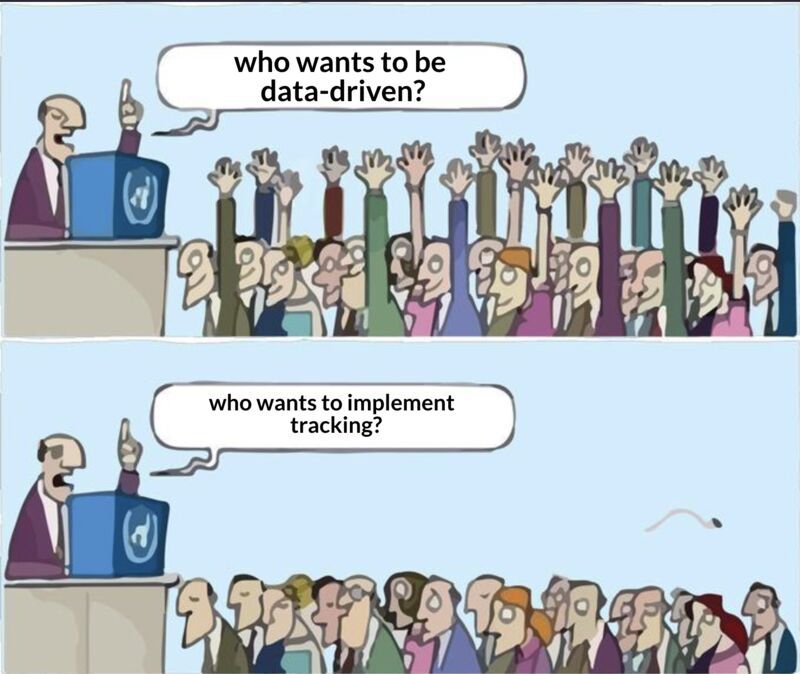
I think we can all safely agree that we have more tools, measurement solutions, dashboards and KPIs than ever before (just try to squint at this graphic if you don’t agree). But it’s also equally true that there is less clarity about what any of it is really for. Teams measure and track because platforms and vendors offer it; because it is expected to be data-driven at a workplace and because your reporting template says so. Another question that often gives this away is to ask what decision did the last measurement study change? Everyone knows that a study was presented. But “presented” is not the end game, right? If a study’s endpoint is a slide - that’s reporting and not decision-driving measurement. Gartner did a study in 2022 and concluded that analytics influences just a little above half of marketing decisions and the reasons to not do so are 1) cherry picking to fit prior opinions 2) decision makers not reading the presented slides/analysis and 3) relying on gut instinct.
What sometimes annoys me though is that incrementality is a reflex answer - this is what conferences and vendor pitches sell. It sounds sophisticated, almost magical. But the reason it is a reflex answer is because a holy-grail answer is socially safe. If the biggest gap is incrementality, nobody in the room is implicated. It’s a hard science problem, likely needs budget and it’s probably someone else’s job. Now compare that with the honest version, which is that ‘none of us actually agree on what counts as a conversion’. It is in part, deflection.
Meanwhile, the unglamorous questions sit unanswered. Is the tracking complete? Is the campaign taxonomy usable, or does every analysis begin with two days of decoding campaign names? Does anyone even open the report that already exists? WARC found in 2024 that only 2% of marketers combine attribution, experiments and MMM - and 22% use no modelling at all. Here is the test I’d use, and I’d ask you to run it yourself: if I told you tomorrow that your campaigns were 30% incremental, would you do anything meaningfully different?
I do think that incrementality is still the right question, eventually. But I guess, the sequence matters?
The only thing on autopilot
In a standard marketing organization, a lot of things go through a planning exercise every year: media plans, creatives, budgets, vendors even. Measurement is probably the only part of the stack that doesn’t see a whole lot of change. The metric set is often inherited from an agency or from a previous employee and a culture of optimization keeps the autopilot on. Teams are rewarded for improving the metrics they have, not for asking whether they’re the right metrics. The industry’s crawl-walk-run maturity frameworks don’t solve this either. Those frameworks rank your methods and not your decisions. A brand can be ‘run’ stage on technique (bi-annual or annual MMM refreshes, always-on testing) and ‘crawl’ stage on decisions, having barely moved dollars because of it. While writing this, I went looking for a stat on how often brands revisit their measurement framework. I couldn’t find one and as far as I can tell, nobody surveys it.
Back to the drawing board
I don’t think I have a magical fix but what I recommend is: one workshop a year and taking the time to answer three questions.
1) What did we measure this year, and what decisions did it change? Do an internal audit of decisions, not activity. Anything that did not change the status quo needs to get fixed.
2) What decisions did we make blindly? This is how gaps should be defined. These are missing inputs to real decisions (“we can’t decide how to split budget between upper and lower funnel”), never as missing methods (“we don’t have MMM”).
3) If we closed that gap, what would we do differently and what is that worth? This is what helps you make that cost benefit analysis and forces the version of a measurement plan I rarely see: with named decisions, owners and thresholds. “We will decide X by Q3, this person owns it, and the result moves at least this much budget.”
Good measurement isn’t about knowing more but mostly about deciding better.